
orybite

Turning startup ideas into polished digital products with speed and precision.
Engineering futuristic digital ecosystems and IT strategic plans to accelerate modern enterprise growth globally.
© 2026 Orybite. All rights reserved.
Built with speed & precision.
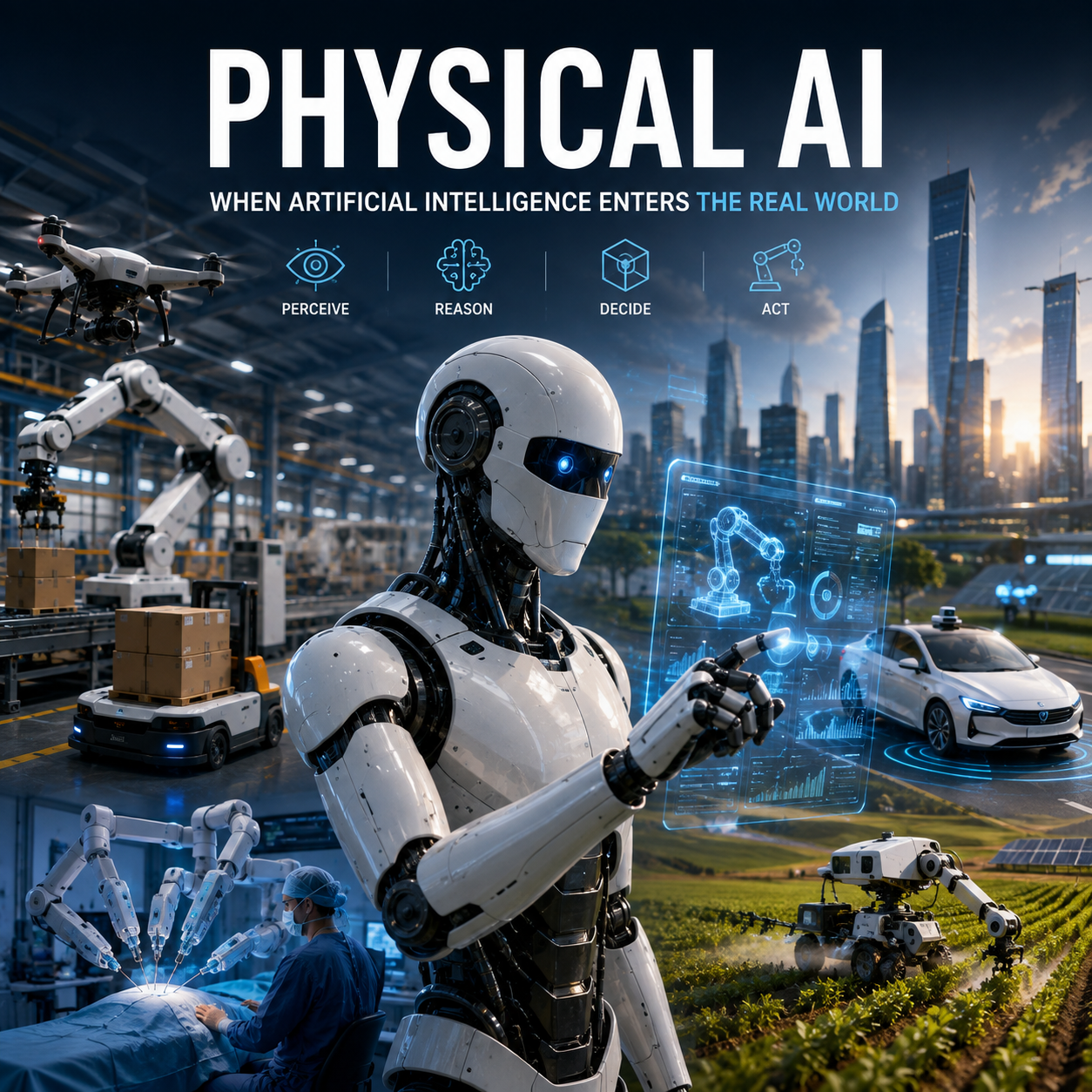
Physical AI: When Artificial Intelligence Enters the Real World Artificial intelligence has traditionally existed primarily in the digital world. AI models can understand text, analyze images, generate software, answer questions, create content, and process enormous amounts of information. But digital intelligence has one fundamental limitation: it cannot directly interact with the physical world without a physical system capable of sensing and acting within it. That is where Physical AI comes in. Physical AI combines artificial intelligence with physical machines such as robots, autonomous vehicles, industrial systems, drones, and other intelligent devices. Instead of simply generating an answer on a screen, a Physical AI system can observe its environment, understand what is happening, make a decision, and perform an action in the real world. This represents an important evolution in AI—from intelligence that primarily processes information to intelligence that can perceive, reason, and act. The World Economic Forum describes Physical AI as the convergence of AI with robotics and industrial automation, where advances in hardware, AI, and vision systems enable robotic systems to perceive, reason, and act autonomously. (World Economic Forum) ⸻ What Is Physical AI? Physical AI is the integration of artificial intelligence with physical machines that can perceive, understand, interact with, and act within the real world. A traditional software AI system might receive a text prompt and generate a response. A Physical AI system has a much more complex loop: Sense → Understand → Reason → Plan → Act → Observe → Learn For example, imagine a warehouse robot instructed to: “Move the damaged package to the inspection area.” The robot must: 1. Understand the instruction. 2. Locate the package. 3. Navigate through the warehouse. 4. Recognize the package. 5. Determine whether it is safe to pick up. 6. Grasp it appropriately. 7. Navigate to the inspection area. 8. Avoid people and obstacles. 9. Place the package correctly. 10. Confirm that the task has been completed. This requires significantly more than language generation. The machine needs perception, spatial understanding, planning, motor control, safety mechanisms, and real-time decision-making. That combination is the foundation of Physical AI. ⸻ Physical AI vs Traditional AI The difference can be understood simply. Traditional AI Traditional AI primarily operates in digital environments. Examples include: * Chatbots * Recommendation systems * Search systems * AI coding assistants * Image-generation systems * Fraud detection * Data analytics These systems process information and produce digital outputs. Physical AI Physical AI connects intelligence to machines that can interact with the physical environment. Examples include: * Humanoid robots * Autonomous mobile robots * Industrial robots * Self-driving vehicles * Agricultural robots * Delivery robots * Drones * Surgical robots * Intelligent manufacturing systems The key difference is embodiment. Stanford’s 2026 Emerging Technology Review describes embodied AI as AI integrated into robots or other physical devices that can sense and act in the physical world. (Stanford Emerging Technology Review) ⸻ Why Physical AI Matters Most of the activities people perform every day happen in physical environments. Factories need machines to assemble products. Warehouses need systems to move goods. Hospitals need equipment to assist healthcare workers. Construction sites require machines to operate in changing environments. Agriculture requires machines to navigate fields and handle crops. Homes contain countless physical tasks that could potentially be automated. Traditional automation works extremely well when the environment is predictable. But real-world environments are rarely perfect. Objects move. Lighting changes. People walk into workspaces. Packages have different shapes. Surfaces change. Machines encounter unexpected situations. This is where AI can provide an important advantage. Instead of programming a robot for every possible situation, AI can help robots interpret their environment and adapt their behavior. ⸻ How Physical AI Works Physical AI typically combines several layers of technology. 1. Sensors Sensors allow machines to collect information about the physical world. Examples include: * Cameras * Depth sensors * LiDAR * Radar * Microphones * Force sensors * Temperature sensors * Inertial measurement units * Tactile sensors These sensors provide the raw information required for the AI system to understand its surroundings. ⸻ 2. Perception The perception layer converts raw sensor information into meaningful information. Computer vision can help a robot identify: * People * Objects * Obstacles * Surfaces * Tools * Vehicles * Packages * Environmental conditions For example, a warehouse robot may use cameras to determine whether a pathway is clear. ⸻ 3. AI Models AI models provide the intelligence layer. Modern robotics increasingly uses foundation models capable of processing multiple forms of information and supporting perception, reasoning, language understanding, and action. Newer approaches include Vision-Language-Action models, which connect visual understanding and language instructions to physical actions. NVIDIA describes these models as a key component in developing robots capable of understanding instructions and performing multi-step tasks. (NVIDIA Blog) ⸻ 4. World Models One of the most important emerging technologies connected to Physical AI is the world model. A world model attempts to represent how an environment behaves. For a robot, understanding the world means more than recognizing an object. It needs to understand questions such as: * What is this object? * Where is it? * Can I pick it up? * What happens if I move it? * Is something blocking my path? * What could happen if I take this action? World models can help AI systems simulate possible outcomes before taking physical actions. Modern Physical AI development is increasingly using world models and simulation to generate training data and evaluate robot behavior before deploying systems in the physical world. (NVIDIA Newsroom) ⸻ 5. Planning and Decision-Making After understanding the environment, the system needs to determine what to do. For example: Goal: Pick up a box. The robot may need to decide: * Which box? * Which route? * Where should it stand? * Which part of the box should it grasp? * How much force should it apply? * Is another robot nearby? * Is a human entering the workspace? This is where AI-based reasoning and planning become critical. ⸻ 6. Actuation Actuators convert decisions into physical movement. They control: * Motors * Robotic arms * Wheels * Grippers * Joints * End effectors The robot therefore completes the loop: AI decision → Control system → Physical movement ⸻ Physical AI Development Requires More Than a Robot It is important to understand that Physical AI is not simply “putting AI into a robot.” A complete Physical AI system may involve: AI models + Sensors + Robotics hardware + Simulation + Training data + Computing + Control systems + Safety + Software infrastructure This makes Physical AI a multidisciplinary technology. It combines: * Artificial intelligence * Robotics * Computer vision * Mechanical engineering * Electrical engineering * Control systems * Simulation * Cloud computing * Edge computing * Semiconductor technology * Data engineering That convergence is one of the reasons Physical AI has become such an important emerging technology area. ⸻ From Rule-Based Robots to AI-Powered Robots Traditional industrial robots are often highly effective but narrowly specialized. A robot may be programmed to: Pick → Move → Place → Repeat If the environment changes significantly, the robot may require reprogramming. AI-powered robots aim to become more adaptable. Instead of relying entirely on fixed instructions, they can potentially learn patterns from demonstrations, simulation, sensor data, and real-world interactions. This is leading to a shift from: Task-specific robots toward: General-purpose and generalist-specialist robots The idea is not necessarily to create a robot that can perform every possible task. Instead, robots could learn a broad range of capabilities while being adapted for specific environments or jobs. Current Physical AI development is explicitly pursuing this generalist-specialist direction. (NVIDIA Blog) ⸻ The Role of Simulation and Digital Twins Training physical machines directly in the real world can be expensive, slow, and potentially dangerous. Imagine training a robot to pick up thousands of objects. If every training attempt happens in a physical factory, developers must deal with: * Hardware wear * Safety risks * Limited training time * Expensive equipment * Human supervision Simulation provides an alternative. A virtual environment can allow robots to practice tasks before they operate in the real world. This can include: * Virtual factories * Warehouses * Roads * Construction environments * Manufacturing lines * Homes * Hospitals Digital twins can also reproduce physical environments for testing and optimization. In 2026, robotics platforms are increasingly combining simulation, synthetic data, robot-learning frameworks, and edge deployment to create cloud-to-robot development workflows. (NVIDIA Blog) ⸻ Synthetic Data: Training Robots Without Building Everything Physically Another important development is synthetic data. Instead of collecting every training example from physical robots, developers can generate simulated environments and scenarios. For example, a warehouse robot could be trained using thousands of virtual situations involving: * Different lighting conditions * Different package sizes * Different floor layouts * Moving workers * Obstacles * Damaged packages * Unexpected objects This can significantly expand the amount of training experience available to a robot. Synthetic data is increasingly becoming an important part of Physical AI development because real-world data collection can be expensive and difficult to scale. (NVIDIA Newsroom) ⸻ Major Applications of Physical AI 1. Manufacturing Manufacturing is one of the most important applications. Physical AI can support: * Assembly * Quality inspection * Material handling * Packaging * Machine tending * Warehouse operations * Predictive maintenance AI-powered machines can potentially adapt to variations in products and production environments instead of performing only perfectly repetitive tasks. ⸻ 2. Warehousing and Logistics Warehouses contain many repetitive physical operations. Physical AI can support: * Picking * Sorting * Packing * Palletizing * Inventory movement * Autonomous navigation * Loading and unloading AI-powered robots can use perception and reasoning to operate in environments shared with human workers. ⸻ 3. Healthcare Physical AI could play an important role in healthcare through: * Surgical robotics * Rehabilitation systems * Hospital logistics * Patient assistance * Laboratory automation * Medical device automation However, healthcare applications require particularly strong validation, safety, regulatory oversight, and human supervision. ⸻ 4. Agriculture Agriculture presents a challenging environment because conditions constantly change. Physical AI can support: * Crop monitoring * Weed detection * Precision spraying * Harvesting * Autonomous tractors * Soil analysis * Agricultural inspection Computer vision and robotics can help machines make decisions based on real-world crop and environmental conditions. ⸻ 5. Construction Construction environments are dynamic and difficult to automate. Physical AI could support: * Site inspection * Material transportation * Autonomous equipment * Surveying * Bricklaying * Excavation * Safety monitoring The ability to understand changing environments is particularly important in construction. ⸻ 6. Transportation Physical AI is also closely connected with autonomous transportation. Applications include: * Autonomous vehicles * Delivery robots * Autonomous trucks * Drones * Port automation * Warehouse transportation systems These systems must continuously perceive their environment and make decisions under uncertainty. ⸻ 7. Retail and Hospitality Physical AI can support: * Inventory management * Shelf monitoring * Cleaning * Food preparation * Delivery * Customer assistance This could create new models for automating repetitive tasks while allowing human workers to focus on customer interaction and higher-value activities. ⸻ 8. Domestic Robotics One of the most ambitious applications is the home. A future household robot could potentially assist with: * Cleaning * Laundry * Kitchen tasks * Object retrieval * Home monitoring * Elderly assistance * General household activities However, homes are extremely unstructured environments, making domestic robotics one of the hardest Physical AI challenges. ⸻ Humanoid Robots and Physical AI Humanoid robots have received significant attention because human environments are already designed around human bodies. Buildings contain: * Stairs * Doors * Shelves * Tools * Workstations * Vehicles * Human-sized equipment A humanoid robot could potentially operate in these environments without requiring every workplace to be redesigned. The challenge is significant. A useful humanoid robot needs to combine: * Balance * Mobility * Dexterity * Perception * Reasoning * Manipulation * Language understanding * Safety * Real-time control In 2026, major robotics companies and research organizations are actively developing humanoid and other autonomous systems using foundation models, simulation, and specialized AI hardware. (NVIDIA Newsroom) ⸻ Physical AI and Product Development Physical AI is also creating a new category of product development. Traditional software products can often be updated through software releases. Physical products require consideration of: * Hardware * Manufacturing * Materials * Sensors * Power consumption * Mechanical design * Software * AI models * Safety * Maintenance This creates a much more complex product lifecycle. For companies building Physical AI products, product development may look like: Concept → Simulation → Hardware Prototype → AI Training → Testing → Real-World Validation → Deployment → Monitoring → Continuous Learning This is an important opportunity for modern product development platforms. Future product development platforms may need to manage not only software requirements and code but also: * Robot behaviors * Simulation environments * Training datasets * AI models * Hardware configurations * Digital twins * Safety tests * Real-world performance data ⸻ The Business Opportunity Behind Physical AI Physical AI could create entirely new businesses rather than simply improving existing ones. Potential business models include: Robotics-as-a-Service Companies could pay for robotic capabilities rather than purchasing and maintaining robots themselves. AI Robot Platforms Companies could provide software and AI models that allow manufacturers to develop intelligent robots. Robot Training Platforms Businesses could provide environments, datasets, and tools for training robotic systems. Simulation-as-a-Service Organizations could simulate robots, factories, warehouses, and other environments before deployment. Robot Fleet Management Companies could build platforms for managing large fleets of autonomous machines. Physical AI Infrastructure New businesses can emerge around: * AI hardware * Sensors * Edge computing * Simulation * Robotics middleware * Training data * Foundation models * Safety systems The business opportunity therefore extends far beyond manufacturing robots themselves. ⸻ Physical AI and the Future of Work The growth of Physical AI will inevitably raise questions about employment. The impact is unlikely to be simply: “Robots replace humans.” A more realistic transition may involve humans and intelligent machines working together. Robots could increasingly perform: * Dangerous tasks * Highly repetitive tasks * Physically demanding tasks * Predictable operational tasks Humans could focus more on: * Decision-making * Creativity * Management * Customer relationships * Problem-solving * Complex judgment This could lead to a new model of work where people manage, supervise, collaborate with, and maintain intelligent machines. However, workforce transitions, job displacement, retraining, workplace safety, and economic inequality will remain important policy and business considerations. ⸻ The Biggest Challenges Facing Physical AI Physical AI has enormous potential, but the technology remains difficult. 1. Real-World Uncertainty Physical environments are unpredictable. AI must handle situations it has never encountered before. 2. Safety A software error may produce incorrect text. A robotic error can cause physical damage or injury. Therefore, Physical AI requires much stronger safety mechanisms. 3. Data Requirements Robots need large amounts of high-quality interaction data. Collecting real-world data can be expensive. 4. Simulation-to-Reality Gap A robot that performs perfectly in simulation may behave differently in the physical world. Bridging this gap remains an important research problem. 5. Hardware Limitations AI capabilities are limited by: * Battery life * Computing power * Sensors * Motors * Mechanical durability * Weight * Cost 6. Cost Advanced robots remain expensive to develop and deploy. Businesses must demonstrate clear economic value before large-scale adoption. 7. Reliability A robot must work reliably not only under ideal conditions but also when the environment changes. 8. Security Connected robots introduce new cybersecurity risks. A compromised robot could potentially cause physical damage, making cybersecurity an essential part of Physical AI development. ⸻ Physical AI Requires Responsible Development As AI moves into physical environments, responsible development becomes even more important. Organizations need to consider: * Human safety * Cybersecurity * Data privacy * AI reliability * Bias * Transparency * Human oversight * Regulatory compliance * Fail-safe mechanisms Physical AI systems should be designed so that failures can be detected and controlled. For high-risk applications, human oversight may remain essential even as autonomous capabilities improve. ⸻ What Comes Next? The next phase of Physical AI is likely to focus on making machines more general, adaptable, and capable of learning from experience. Several technology trends are particularly important. World Foundation Models Models that understand physical environments could help robots reason about how scenes change and how actions affect the world. Vision-Language-Action Models These models connect visual perception, language instructions, reasoning, and physical actions. World Action Models Research is moving beyond simply understanding the world toward models that can predict both future states and actions. Recent 2026 research from NVIDIA describes world-action-model approaches for robot manipulation that use learned physical dynamics to improve generalization and reduce the amount of real-world training data required. (NVIDIA Developer) Better Simulation More realistic simulation environments will allow robots to receive more training before physical deployment. Edge AI Robots need fast decision-making, which increases the importance of AI processing close to the machine. More Capable Humanoids Advances in perception, manipulation, mobility, and AI models could gradually expand the range of tasks humanoid robots can perform. ⸻ Physical AI Is the Convergence of Multiple Technologies The real significance of Physical AI is that it brings together several technology domains. Artificial Intelligence ↓ Computer Vision ↓ Robotics ↓ Sensors ↓ World Models ↓ Simulation & Digital Twins ↓ Edge Computing ↓ Autonomous Decision-Making ↓ Physical Action This convergence could create a new generation of intelligent machines capable of operating alongside humans. ⸻ Conclusion Physical AI represents a major evolution in artificial intelligence. Traditional AI primarily works with information. Physical AI takes the next step by giving intelligence a physical presence. A Physical AI system can see its surroundings, understand what is happening, reason about possible actions, make decisions, and interact with the physical world. From factories and warehouses to hospitals, agriculture, transportation, construction, and eventually homes, the potential applications are enormous. The technology is still developing, and significant challenges remain around safety, reliability, cost, data, hardware, simulation, and real-world generalization. But the direction is clear. AI is moving beyond screens. It is beginning to enter factories, warehouses, roads, farms, hospitals, construction sites, and other physical environments. The next generation of intelligent products may therefore not be applications that simply respond to users. They may be machines that understand the world and act within it. That is the promise of Physical AI.