orybite
Turning startup ideas into polished digital products with speed and precision.
Engineering futuristic digital ecosystems and IT strategic plans to accelerate modern enterprise growth globally.
© 2026 Orybite. All rights reserved.
Built with speed & precision.
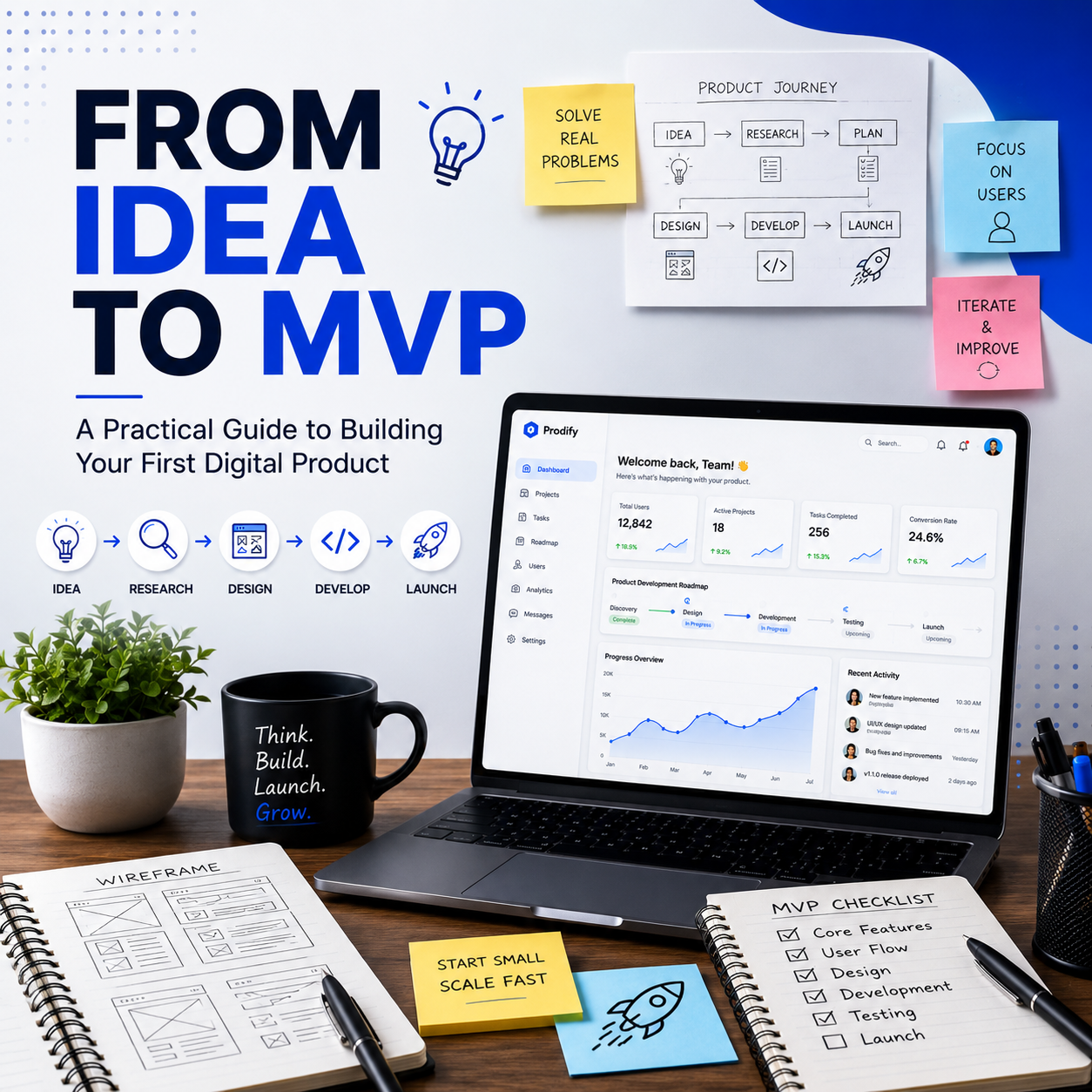
From Idea to MVP: A Practical Guide to Building Your First Digital Product Every successful digital product starts with an idea. But an idea alone is not a product. Whether you are building a SaaS platform, mobile application, marketplace, healthcare solution, fintech product, or internal business tool, transforming an idea into something people actually use requires a structured product development process. One of the most effective approaches is to build a Minimum Viable Product (MVP). An MVP allows businesses and startups to transform an idea into a functional product with the essential features needed to solve a specific user problem. Instead of spending months building a product with dozens of features, teams can launch a focused version, collect feedback, learn from real users, and improve the product based on actual demand. In this guide, we will explore the key steps involved in taking a digital product from an initial idea to a functional MVP. 1. Start With the Problem, Not the Product One of the most common mistakes in product development is starting with the solution before clearly understanding the problem. Before deciding what your product should look like, ask: * What problem are we trying to solve? * Who experiences this problem? * How frequently does the problem occur? * How are people solving it today? * Why are existing solutions not sufficient? * Would users actually pay for a better solution? A strong product usually solves a meaningful problem for a clearly defined group of users. For example, instead of saying: “We want to build a project management application.” A stronger product statement would be: “Small development teams need a simpler way to track tasks, communicate project updates, and identify blockers without using complicated enterprise tools.” The second statement identifies the user, problem, and desired outcome. That clarity becomes the foundation for the entire product development process. 2. Understand Your Target Users Once the problem is defined, the next step is understanding the people who experience it. User research helps product teams understand users’ needs, expectations, frustrations, behaviors, and goals. Depending on the product, research can include: * User interviews * Surveys * Competitor analysis * Customer reviews * Usability testing * Market research * Existing product analytics The goal is not simply to collect information. The goal is to identify patterns. For example, if you are developing a healthcare scheduling platform, you might discover that healthcare professionals are not primarily concerned about having more features. Their biggest frustration might be the amount of time spent managing appointments manually. That insight could completely change your product priorities. 3. Define Your Product Requirements After understanding the users and their problems, convert your findings into clear product requirements. At this stage, identify what the product must do to solve the core problem. A useful approach is to divide requirements into three groups: Must-Have Features These are essential for the MVP to provide its core value. For example: * User registration * Login * User profile * Core workflow * Basic dashboard * Essential notifications Should-Have Features These improve the experience but may not be necessary for the first release. Examples include: * Advanced filtering * Custom reports * Additional integrations * Personalization Nice-to-Have Features These can usually wait until later versions. Examples include: * Advanced analytics * AI-powered recommendations * Complex automation * Extensive customization This prioritization prevents teams from trying to build everything at once. 4. Define the MVP Scope The purpose of an MVP is not to build the smallest product possible. It is to build the smallest useful product that can validate your core assumption. Imagine you are building a food delivery platform. A complete platform could eventually include: * Customer applications * Restaurant dashboards * Delivery partner applications * Payment systems * Loyalty programs * Ratings and reviews * Real-time tracking * Promotions * Advanced analytics Building everything before testing the concept could require significant time and resources. Instead, an MVP might focus on: 1. Customer registration 2. Restaurant listings 3. Menu browsing 4. Order placement 5. Basic payment 6. Order status tracking Once users start using the product, the team can identify which additional features actually matter. 5. Create User Flows Before designing individual screens, map out how users will interact with the product. A user flow describes the steps a user takes to accomplish a specific goal. For example: Sign Up → Select Service → Choose Date → Confirm Booking → Receive Confirmation Creating user flows helps teams identify unnecessary steps, confusing interactions, and missing functionality before development begins. It also gives designers and developers a shared understanding of how the product should work. 6. Design the Product Once the product flow is clear, the design phase can begin. Product design typically includes: Wireframes Wireframes provide a basic structure for each screen. They focus on: * Layout * Navigation * Content placement * User actions * Information hierarchy UI Design The next step is creating the visual interface. This includes: * Colors * Typography * Buttons * Forms * Icons * Cards * Navigation * Responsive layouts Prototyping A clickable prototype allows stakeholders and potential users to experience the product before development begins. This is extremely valuable because usability problems can often be identified and corrected during design rather than after the product has already been developed. 7. Choose the Right Technology Technology decisions should support the product’s requirements rather than simply follow the latest trends. Depending on the product, the technology stack might include: * Frontend frameworks * Backend technologies * Databases * Cloud infrastructure * APIs * Authentication systems * Payment services * Analytics tools For example, a modern web application might use a JavaScript-based frontend, a backend API, a cloud database, and cloud hosting. The right technology depends on factors such as: * Product complexity * Expected users * Performance requirements * Security requirements * Development expertise * Budget * Future scalability The objective is to choose technology that allows the team to build, test, and improve the product efficiently. 8. Develop the MVP With requirements, user flows, designs, and technology decisions in place, development can begin. A good development process usually breaks the MVP into smaller deliverables. Instead of attempting to build the entire product simultaneously, teams can work through individual features or user journeys. For example: Sprint 1: Authentication and user accounts Sprint 2: Core product workflow Sprint 3: Dashboard and notifications Sprint 4: Testing, optimization, and deployment Working incrementally makes it easier to identify problems early and keep stakeholders involved throughout development. 9. Test Before Launch Testing should happen throughout the development process rather than only at the end. Depending on the product, testing may include: * Functional testing * Usability testing * Performance testing * Security testing * Compatibility testing * API testing * Regression testing The team should verify that the product not only works technically but also provides a smooth experience for users. A feature that works correctly from a technical perspective can still create problems if users do not understand how to use it. 10. Launch to Real Users Once the MVP is stable, it is time to put it in front of real users. The first launch does not have to target everyone. A controlled launch with a smaller group of users can provide valuable insights while reducing risk. During the initial launch, monitor: * User adoption * Activation rates * Feature usage * User retention * Conversion rates * Customer feedback * Support requests * Technical issues The goal of the MVP launch is learning. A successful MVP is not necessarily the product with the most users immediately. It is the product that helps the team learn whether its assumptions are correct. 11. Collect Feedback and Iterate Launching the MVP is not the end of product development. It is the beginning of the next phase. Real users will reveal things that internal teams may not have anticipated. They might: * Ignore a feature the team considered important. * Request a feature that was not originally planned. * Struggle with a particular workflow. * Discover new use cases. * Suggest a simpler way to accomplish a task. Product teams should analyze this feedback and prioritize improvements based on user needs and business goals. This creates a continuous cycle: Build → Launch → Measure → Learn → Improve → Repeat This iterative approach allows products to evolve based on evidence rather than assumptions. 12. Common MVP Mistakes to Avoid Building Too Many Features Adding more features does not automatically make an MVP better. Too many features can increase development time, complexity, and cost while making it harder to determine what users actually value. Skipping User Research Building based entirely on assumptions can result in a product nobody needs. Even lightweight research can provide valuable insights before development begins. Focusing Only on Technology A technically impressive product can still fail if it does not solve a meaningful user problem. Technology should enable the product strategy, not replace it. Ignoring User Experience Users expect products to be intuitive and easy to use. A confusing interface can prevent adoption even when the underlying functionality is strong. Treating Launch as the Finish Line An MVP is designed to learn from the market. After launch, product teams should continue measuring, learning, and improving. The Role of a Product Development Platform Building a digital product often involves multiple teams, tools, documents, and processes. A product development platform can help bring these activities together by providing a centralized environment for managing product ideas, requirements, design, development, collaboration, testing, and feedback. Instead of managing every stage separately, teams can create a more connected product development workflow. This can improve: * Team collaboration * Visibility * Product planning * Communication * Development efficiency * Decision-making * Product iteration For growing teams, having a structured product development process can make the difference between simply having an idea and successfully bringing that idea to market. Final Thoughts Building a digital product does not require having every detail figured out from day one. The key is to start with a meaningful problem, understand your users, define a focused MVP, build the essential functionality, and learn from real-world feedback. The most effective product development process is rarely a straight line. It is an ongoing cycle of discovery, design, development, testing, learning, and improvement. By focusing on solving real problems instead of simply adding features, teams can reduce unnecessary development effort, make better product decisions, and create digital experiences that provide genuine value to users. Your idea is only the beginning. The real product journey starts when you turn that idea into something users can experience, evaluate, and improve with you.