
orybite

Turning startup ideas into polished digital products with speed and precision.
Engineering futuristic digital ecosystems and IT strategic plans to accelerate modern enterprise growth globally.
© 2026 Orybite. All rights reserved.
Built with speed & precision.
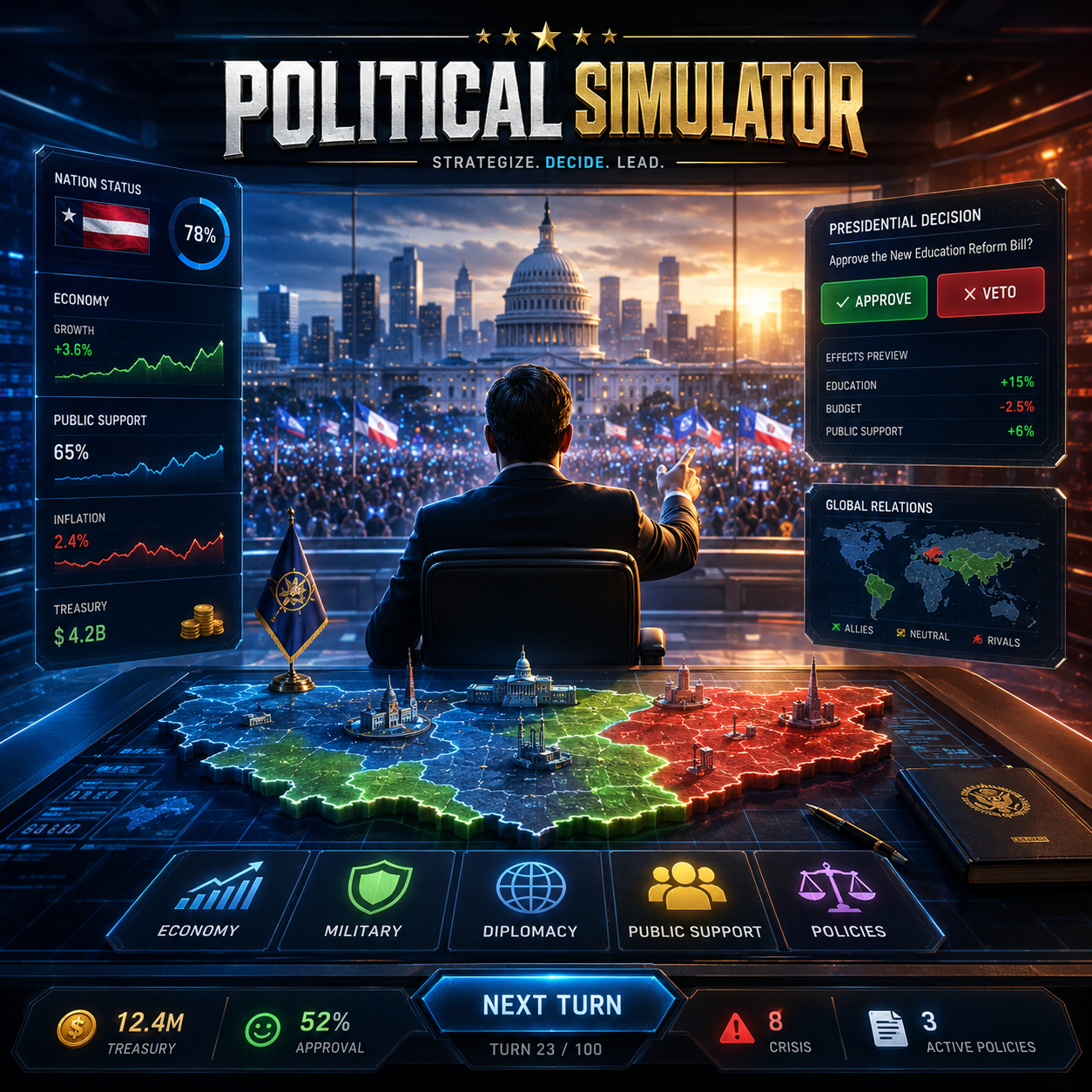
Building Political & Dictator Simulator Games in Flutter: Cost, Revenue, Market Stats, and Future Outlook Political and dictator simulator games form a highly profitable, high-engagement genre in modern gaming. Players step into the shoes of presidents or supreme leaders, making complex socio-economic and legislative decisions. This report details the market dynamics, development economics, challenges, and why Flutter (with Flame) is an ideal technical framework for this genre. 1. Market Overview & Top Games Performance The audience for political strategy simulators is exceptionally loyal and demonstrates a high lifetime value (LTV). Major players dominating this market segment include: • Suzerain: A critically acclaimed narrative-driven political drama. Downloads/Sales: Over 160,000 paid copies sold on Steam, alongside hundreds of thousands of active mobile users. Estimated Revenue: Lifetime gross revenue ranges between $4.0 Million and $6.1 Million. • Democracy 4: A pure, data-driven political and policy-making simulation. Downloads/Sales: Over 190,000 premium copies sold worldwide. Estimated Revenue: Premium base game sales alone account for roughly $3.5 Million. • Tropico (Mobile): A 3D/2D construction and dictator management sim. Downloads/Sales: Boasts over 500,000+ paid downloads across Android and iOS premium storefronts. • RandomNation: A casual political mobile simulator serving as an excellent free-to-play benchmark. Downloads/Sales: Exceeds 1 Million+ downloads on the Google Play Store, monetizing effectively through ad-removal passes and premium feature unlocks. 2. Development Cost Breakdown Unlike traditional action games, political simulators rely heavily on user interfaces, intricate logic loops, and rich textual narratives rather than heavy 3D asset generation. Cost structures vary based on scope: • Minimum Viable Product (MVP) Scale: Developed by a lean team of 1-2 engineers over 6 months, focusing strictly on text, menus, data metrics, and basic choice logic. Estimated Budget: $10,000 to $25,000. • Studio Grade / Full Scale: Deep narrative design, extensive variable matrices, premium artwork, soundtrack, full localization across multiple languages, and thorough quality assurance. Estimated Budget: $50,000 to $120,000. 3. Monetization Architecture Developers leverage distinct monetization pipelines depending on their primary target platforms: • Premium Desktop Model (PC/Mac): Straightforward upfront purchase pricing ranging from $15 to $30 on platforms like Steam and Epic Games Store, supplemented by paid DLC packs. • Freemium Hybrid Model (Mobile): Offering the initial phase of gameplay (e.g., the first term or year of presidency) entirely for free. Further narrative progression is gated behind Story Expansion Packs ($4.99 - $9.99) or unlocked via a Lifetime Ad-Free VIP Pass. 4. Core Development Challenges & Why Costs Rise The complexity—and therefore the cost—of producing these games has scaled due to three specific factors: 1. Interconnected State Machines: In a political simulator, variables never exist in isolation. If a player raises corporate tax rates, the simulator must calculate cascading effects: treasury revenue increases, corporate investment dips, unemployment ticks upward, public satisfaction drops, and corruption risks fluctuate. Designing these balanced mathematical loops requires deep backend engineering. 2. Combinatorial Narrative Explosion: Branching player choices result in exponential scenario pathways. If a script involves 50 critical decision points, they can generate hundreds of unique political outcomes. Writing, localizing, and QA-testing every branch becomes highly resource-intensive. 3. Cross-Platform Maintenance: Modern players expect continuous cross-progression between PC, Android, and iOS. Historically, writing separate native apps multiplied development costs. 5. Why Flutter & Flame Provide the Ideal Technical Fix Flutter has shifted from a mobile framework to an excellent tool for data-dense, UI-centric strategy games: • Unified Single Codebase: Write the core systems, logic matrices, and UI layout once in Dart. Compile natively to Android, iOS, Windows, macOS, and Web simultaneously. This eliminates redundant platform teams and **reduces development overhead by up to 50%**. • High-Performance UI Rendering: Driven by the Impeller and Skia graphics engines, Flutter renders dense data sheets, active dynamic charts, text dialogs, and reports with fluid, 60fps responsiveness. • The Flame Engine Advantage: If your simulator needs visual infrastructure—such as an interactive 2D map, border control zones, or animated avatars—the Flame Engine bridges the gap perfectly, handling game loop ticks and resource caching natively within Flutter widgets. 6. Future Outlook of the Genre • Generative AI Integrations: The next frontier involves swapping pre-scripted dialog trees for local or API-driven LLMs. Players will engage in unscripted verbal or textual diplomatic negotiations with foreign leaders or cabinet ministers, creating infinite replayability. • Live-Data Injection: Modern simulators are exploring real-time external data feeds. Global economic shifts, actual inflation spikes, or real geopolitical crises can be translated directly into the game loop as dynamic live scenarios. This is for informational purposes only.