
orybite

Turning startup ideas into polished digital products with speed and precision.
Engineering futuristic digital ecosystems and IT strategic plans to accelerate modern enterprise growth globally.
© 2026 Orybite. All rights reserved.
Built with speed & precision.
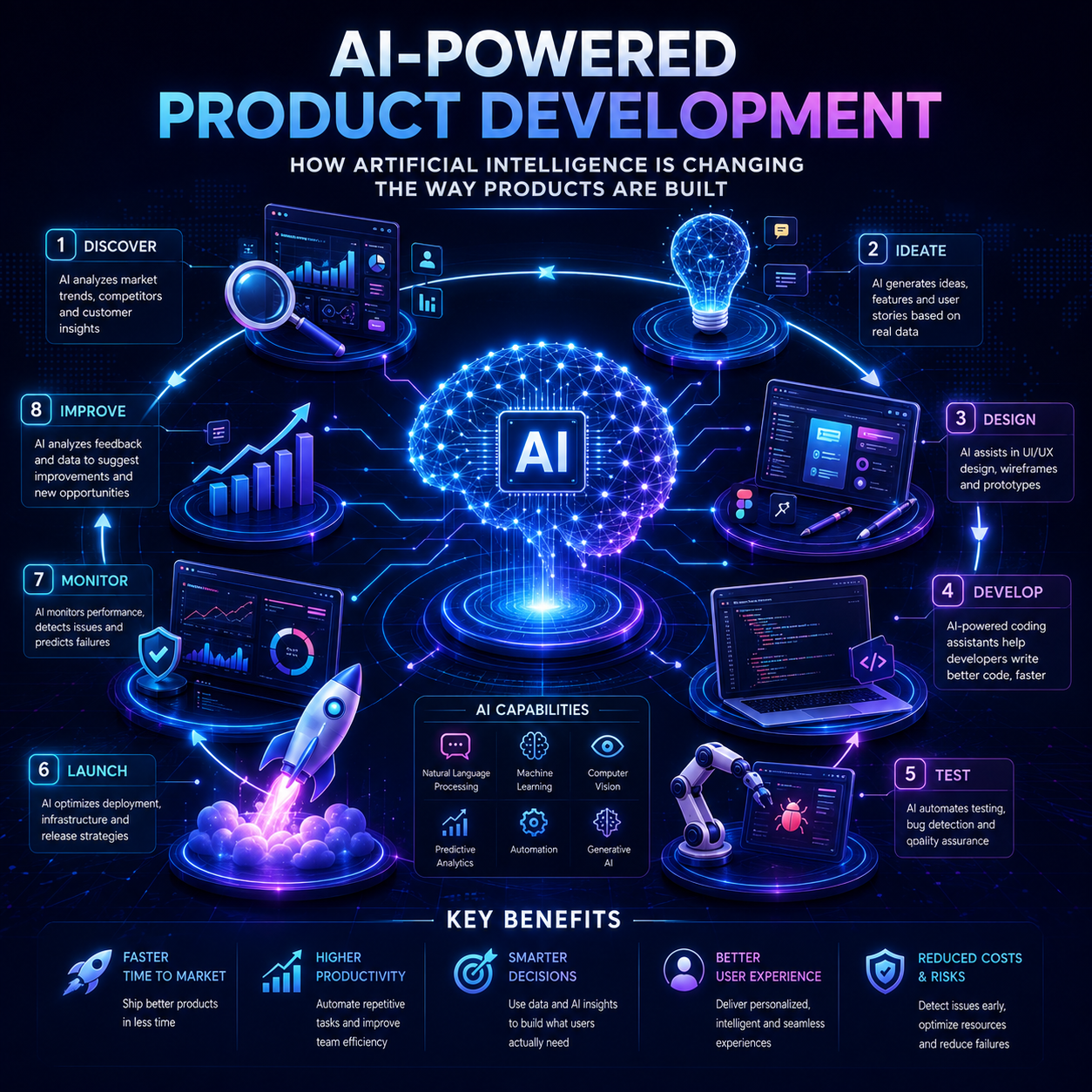
AI-Powered Product Development: How Artificial Intelligence Is Changing the Way Products Are Built Artificial Intelligence is no longer limited to chatbots, recommendation engines, or automated business processes. It is becoming an important capability across the entire product development lifecycle. From identifying customer problems to designing solutions, writing software, testing products, analyzing user behavior, and planning future improvements, AI is changing how product teams work. Modern AI-powered product development combines technologies such as Generative AI, Machine Learning, Natural Language Processing, Computer Vision, Predictive Analytics, intelligent automation, and AI agents with established product management, design, engineering, and quality processes. The objective is not simply to automate product development. The bigger opportunity is to create a more intelligent product development system where teams can process information faster, make better decisions, reduce repetitive work, identify risks earlier, and continuously learn from real-world product data. Recent research examining 98 peer-reviewed studies on AI and new product development found that AI’s impact extends across multiple stages and can accumulate from early ideation through development, testing, launch, and post-launch learning. (DOI) ⸻ What Is AI-Powered Product Development? AI-powered product development is the use of artificial intelligence technologies to support, augment, and automate activities across the product development lifecycle. Traditional product development often depends on manual research, human analysis, repetitive engineering tasks, conventional testing, and periodic feedback cycles. AI introduces an additional intelligence layer that can analyze large volumes of information, recognize patterns, generate content and solutions, make predictions, automate workflows, and provide recommendations. A modern AI-powered product development lifecycle can include: 1. Discover – Understand markets, customers, competitors, and problems. 2. Ideate – Generate and evaluate product concepts. 3. Design – Create experiences, wireframes, prototypes, and specifications. 4. Develop – Build software and product components more efficiently. 5. Test – Automate testing, validation, and quality analysis. 6. Launch – Optimize deployment, infrastructure, and release strategies. 7. Monitor – Track product performance and user behavior. 8. Improve – Analyze feedback and continuously optimize the product. The lifecycle is not necessarily linear. Insights from testing or real-world usage can send teams back to design or development, creating a continuous product improvement loop. ⸻ Why AI Is Becoming Important in Product Development Product teams today operate in an environment where customer expectations change rapidly and competition is global. Organizations need to: * Understand customers quickly * Validate ideas before investing heavily * Reduce development cycles * Deliver high-quality products * Personalize customer experiences * Detect problems earlier * Make data-driven decisions * Continuously improve products Traditional processes can struggle when the volume of information and speed of change become too high. AI can help product teams process information at a much greater scale. Instead of asking teams to manually analyze thousands of customer reviews, support tickets, product analytics events, or market signals, AI can help summarize, classify, identify patterns, and surface important insights. This is one reason organizations are increasingly looking beyond AI coding assistants toward AI-enabled transformation of the broader product development lifecycle. McKinsey describes this shift as integrating AI across the end-to-end software product development lifecycle rather than using AI only for individual engineering tasks. (McKinsey & Company) ⸻ The 8 Stages of AI-Powered Product Development 1. Discover: Turning Data Into Product Insights Every successful product starts with a clear understanding of the problem. The discovery stage involves understanding: * Customer needs * Market trends * Competitor products * Customer pain points * Business opportunities * Industry changes * Existing product limitations AI can accelerate discovery by analyzing large amounts of structured and unstructured information. For example, an AI system can analyze thousands of customer reviews and identify recurring complaints, frequently requested features, and changes in customer sentiment. AI can also help product teams summarize research documents, compare competitors, identify emerging trends, and organize customer feedback. AI can support: * Market research * Competitor analysis * Customer sentiment analysis * Review analysis * Survey analysis * Customer segmentation * Trend identification * Opportunity discovery The result is a more data-informed foundation for product strategy. ⸻ 2. Ideate: Using AI to Expand Product Possibilities Once an opportunity has been identified, teams need to determine what they should build. Generative AI can act as a brainstorming and ideation partner. It can help teams: * Generate product concepts * Create feature ideas * Develop user stories * Identify alternative solutions * Generate product requirements * Explore different customer scenarios * Compare potential approaches For example, if a company wants to develop a healthcare platform, AI could help generate possible features such as intelligent appointment scheduling, personalized dashboards, automated documentation, predictive analytics, and AI-assisted customer support. However, AI-generated ideas should not automatically become product requirements. Human product managers must evaluate each idea against: * Customer value * Business objectives * Technical feasibility * Cost * Security * Regulatory requirements * Market demand AI expands the possibility space; humans provide strategic judgment. ⸻ 3. Design: Building Better Product Experiences AI is also changing product design. Designers can use AI to accelerate activities such as: * Wireframe generation * UI concept generation * Prototype creation * Design exploration * Content generation * User-flow analysis * Accessibility analysis * Personalization AI can also analyze how users interact with existing products. For example, product analytics combined with AI can help identify: * Where users abandon a process * Which features receive the most engagement * Which screens cause friction * Which user journeys are most successful This information can help teams make evidence-based UX decisions. AI does not eliminate the importance of UX designers. Instead, it can reduce repetitive work and allow designers to spend more time on user empathy, product strategy, interaction design, and creative problem-solving. ⸻ 4. Develop: Accelerating Product Engineering Software development is one of the areas where AI has already become highly visible. AI-powered development tools can assist engineers with: * Code generation * Code completion * Debugging * Refactoring * Documentation * Test generation * Code explanation * Dependency analysis * Development workflow automation For example, a developer can use AI to generate an initial API endpoint, create unit tests, explain unfamiliar code, or identify potential implementation issues. This can reduce time spent on repetitive engineering activities. However, AI-generated code should always be reviewed by qualified developers. Important areas requiring human review include: * Security * Architecture * Performance * Business logic * Data privacy * Maintainability * Scalability * Regulatory compliance The professional goal should therefore be AI-assisted engineering, not blindly accepting AI-generated code. ⸻ 5. Test: Making Quality Assurance More Intelligent Testing is essential to product quality, but traditional testing can require significant time and resources. AI can support quality assurance by helping teams: * Generate test cases * Identify potential defects * Analyze application behavior * Automate regression testing * Prioritize high-risk test areas * Detect anomalies * Simulate user behavior * Analyze test results For complex products, AI can also support simulation and virtual testing. Research into AI in new product development highlights applications such as AI-supported test planning, digital twins, simulation, and virtual validation as ways to increase testing scale and identify weaknesses earlier. (DOI) The objective is not simply to test more. It is to identify important problems earlier and improve the efficiency of the quality process. ⸻ 6. Launch: Moving From Development to Production A successful product launch requires more than completing development. Teams must manage: * Infrastructure * Deployment * Scalability * Performance * Release planning * Monitoring * Security * Resource utilization AI can assist with launch optimization by analyzing historical and real-time information. For example, AI can help identify unusual traffic patterns, estimate resource requirements, detect deployment anomalies, and support infrastructure optimization. AI can also help teams analyze previous releases to understand what worked and what should be changed in future launches. This can make the transition from development to production more predictable. ⸻ 7. Monitor: Learning From Real-World Product Behavior Launching a product is not the end of development. Once a product reaches customers, organizations begin receiving valuable information about: * User behavior * Product performance * Errors * Customer engagement * Feature adoption * Conversion rates * Support requests * Customer satisfaction AI can continuously analyze these signals. For example, an AI-powered monitoring system could detect that a particular feature is generating an unusual increase in errors or that users are abandoning a specific workflow. Instead of waiting for a periodic manual report, teams can receive faster insights and investigate potential problems earlier. ⸻ 8. Improve: Creating a Continuous Product Learning Loop One of the most important advantages of AI-powered product development is continuous learning. After launch, AI can analyze: User behavior → Feedback → Product data → AI insights → Product decisions → New improvements This creates a continuous feedback loop. For example: 1. Users report difficulty with a feature. 2. AI analyzes support tickets and reviews. 3. AI identifies the common issue. 4. Product managers evaluate the finding. 5. Designers develop an improved experience. 6. Developers implement the change. 7. Testing validates the improvement. 8. Analytics measure the result. The process then begins again. This transforms product development from a one-time project into a continuous learning and optimization system. ⸻ AI Technologies Powering Modern Product Development Generative AI Generative AI can create new content based on prompts and available information. Product teams can use it for: * Product concepts * User stories * Documentation * Code * Test cases * UX content * Prototypes * Product specifications ⸻ Machine Learning Machine learning identifies patterns in data and uses those patterns to make predictions or classifications. Applications include: * Demand forecasting * Recommendation systems * Customer segmentation * Predictive maintenance * Risk prediction * Customer behavior analysis ⸻ Natural Language Processing NLP enables systems to process and understand human language. It can analyze: * Customer feedback * Support tickets * Reviews * Surveys * Requirements * Documentation * Conversations ⸻ Computer Vision Computer vision allows AI systems to interpret visual information. Potential applications include: * Image classification * Object detection * Quality inspection * Visual search * Document processing * Medical imaging * Product inspection ⸻ Predictive Analytics Predictive analytics uses historical and current data to estimate potential future outcomes. Product teams can use it to forecast: * Customer demand * Product adoption * Churn * System failures * Sales * Customer behavior ⸻ AI Agents and Intelligent Automation The next evolution of AI-powered product development involves AI agents capable of executing multi-step workflows rather than simply responding to individual prompts. For example, an AI-enabled workflow could potentially: Analyze requirements → Generate implementation tasks → Produce code → Generate tests → Run validation → Identify issues → Suggest fixes → Prepare documentation The important shift is from using AI as an isolated assistant to integrating AI into the overall product development workflow. Recent industry research describes this transition toward redesigning product development systems around AI and agents rather than simply adding another AI tool to existing processes. (McKinsey & Company) ⸻ Key Benefits of AI-Powered Product Development 1. Faster Time to Market AI can accelerate research, ideation, prototyping, engineering, and testing, helping teams move through development cycles more efficiently. 2. Higher Productivity Automating repetitive activities allows product professionals to spend more time on strategic and creative work. 3. Better Decision-Making AI can process large volumes of information and provide insights that support more informed decisions. 4. Improved Product Quality AI-assisted testing, monitoring, analytics, and validation can help identify problems earlier. 5. Better Customer Experience Analyzing customer behavior and feedback allows teams to create more relevant and personalized experiences. 6. Reduced Development Risk Predictive analytics and early validation can help teams identify potential problems before significant resources are committed. 7. Continuous Improvement AI can transform post-launch data into actionable insights, creating an ongoing improvement cycle. 8. Improved Resource Utilization Automation allows teams to focus human effort on activities where expertise and judgment provide the greatest value. Research on AI in new product development identifies three broad benefit categories: greater process efficiency and information-processing speed, improved decision quality and risk reduction, and stronger customer alignment and iterative learning. (DOI) AI-Powered Product Development vs Traditional Product Development The key differences between traditional and AI-powered product development can be understood across the major stages of the product lifecycle: 1. Market Research Traditional Product Development: Market research mainly depends on manual data collection, surveys, interviews, and analysis. AI-Powered Product Development: AI can analyze large volumes of market, customer, competitor, and industry data to identify trends and opportunities faster. 2. Customer Feedback Traditional Product Development: Teams manually review customer reviews, surveys, emails, and support requests. AI-Powered Product Development: AI can automatically analyze customer feedback, identify common issues, detect sentiment, and highlight recurring customer needs. 3. Product Ideation Traditional Product Development: Product ideas are primarily generated through brainstorming sessions and human research. AI-Powered Product Development: AI can assist teams by generating product concepts, feature ideas, user stories, and alternative solutions. 4. Product Design Traditional Product Development: Designers manually create wireframes, prototypes, and design variations. AI-Powered Product Development: AI can assist with design concepts, prototypes, user flows, content, and experience analysis. 5. Software Development Traditional Product Development: Developers write, review, debug, and document most code manually. AI-Powered Product Development: AI coding tools can assist with code generation, debugging, refactoring, documentation, and test creation. 6. Testing and Quality Assurance Traditional Product Development: Testing often relies on predefined manual and automated test processes. AI-Powered Product Development: AI can help generate test cases, identify potential defects, analyze test results, and prioritize high-risk areas. 7. Product Launch Traditional Product Development: Deployment and release decisions are largely based on predefined processes and historical experience. AI-Powered Product Development: AI can analyze deployment data, infrastructure requirements, traffic patterns, and system performance to support more efficient releases. 8. Product Monitoring Traditional Product Development: Teams often depend on dashboards, alerts, and periodic manual analysis. AI-Powered Product Development: AI can continuously analyze product data and identify unusual behavior, performance issues, and emerging risks. 9. Product Improvement Traditional Product Development: Product improvements are often planned through periodic reviews and release cycles. AI-Powered Product Development: AI can continuously analyze user behavior, feedback, and product performance to identify opportunities for improvement. 10. Decision-Making Traditional Product Development: Decisions may rely heavily on human analysis, experience, and periodic reporting. AI-Powered Product Development: AI provides data-driven insights and predictions that can support faster and more informed decisions. In Simple Terms Traditional product development primarily depends on human research, manual processes, predefined workflows, and periodic analysis. AI-powered product development combines human expertise with artificial intelligence, automation, real-time data analysis, predictive insights, and continuous learning. Human Expertise Still Matters AI-powered product development does not mean removing humans from the process. Human expertise remains essential for: * Product strategy * Customer empathy * Business judgment * Ethical decisions * Risk assessment * Architecture * Creative direction * Regulatory decisions * Quality control * Accountability AI can recommend an action, but organizations still need people who understand why the action matters and whether it is appropriate. A successful model is therefore: Human Expertise + AI Capabilities + High-Quality Data + Strong Product Processes ⸻ Challenges of AI-Powered Product Development AI creates significant opportunities, but organizations must also manage its limitations. Data Quality AI systems depend heavily on data. Poor-quality or incomplete data can lead to unreliable insights. Data Privacy Products handling personal or sensitive information require strong privacy and security controls. Bias AI systems can reproduce or amplify biases present in training or operational data. Accuracy and Reliability AI-generated outputs can contain errors or misleading information. Critical outputs require appropriate validation. Security AI-generated code and AI-enabled workflows can introduce security risks if they are not properly reviewed. Integration Organizations may need to integrate AI with existing product, engineering, analytics, and business systems. Governance Organizations need clear rules for AI usage, access, monitoring, accountability, and risk management. Organizational Change AI adoption can change workflows, responsibilities, and required skills. Successful implementation therefore requires more than simply purchasing AI tools. Research on AI-driven product development emphasizes the importance of human oversight, accountability, explainability, and risk management as AI becomes more deeply integrated into product creation. (arXiv) ⸻ How Organizations Can Successfully Adopt AI in Product Development A professional AI adoption strategy should begin with business problems rather than technology. Step 1: Identify High-Value Problems Determine which product development activities are expensive, repetitive, slow, or difficult to scale. Step 2: Define Success Metrics Establish measurable objectives before implementing AI. Examples include: * Reduced development cycle time * Faster testing * Lower defect rates * Improved customer satisfaction * Increased feature adoption * Reduced operational costs Step 3: Assess Data Readiness Evaluate whether the organization has the required data and whether that data is accurate, accessible, secure, and usable. Step 4: Select the Appropriate AI Approach Not every problem requires the same technology. Depending on the use case, organizations may use: * Generative AI * Machine learning * Predictive analytics * Retrieval-augmented generation * AI agents * Computer vision * Natural language processing Step 5: Start With a Focused Use Case Instead of attempting to transform everything at once, organizations can begin with a clearly defined high-value workflow. Step 6: Establish Human Oversight Define where AI can operate independently and where human approval is required. Step 7: Measure Results Compare AI-enabled workflows against existing processes using clearly defined KPIs. Step 8: Scale What Works Once a use case demonstrates measurable value, organizations can expand AI capabilities to additional stages of the product lifecycle. ⸻ Key Metrics for Measuring AI-Powered Product Development Organizations should measure AI adoption through business and product outcomes rather than simply counting how many AI tools employees use. Useful KPIs include: * Time to market * Development cycle time * Lead time for changes * Deployment frequency * Defect rate * Test coverage * Mean time to resolution * Product adoption * Feature adoption * Customer satisfaction * Customer retention * Development cost * Engineering productivity * AI output acceptance rate * AI-assisted task completion time These measurements help determine whether AI is producing actual business value. ⸻ The Future of AI-Powered Product Development The future of product development is moving beyond isolated AI tools toward AI-enabled product development ecosystems. AI is increasingly being integrated across the complete lifecycle rather than being used only for individual tasks. Future product development environments are likely to place greater emphasis on: * AI-assisted product strategy * Autonomous and semi-autonomous workflows * AI agents * Intelligent product analytics * AI-assisted software engineering * Automated testing * Predictive product management * Personalized user experiences * Continuous product optimization * AI governance and responsible AI The most important transformation may therefore not be the introduction of one particular AI model or tool. It is the redesign of how product teams work. Organizations that successfully adopt AI are likely to combine AI capabilities with redesigned workflows, clear responsibilities, verification mechanisms, governance, and continuous measurement. Recent industry analysis similarly points toward redesigning the operating model around AI rather than treating AI as simply another productivity tool. (McKinsey & Company) ⸻ Conclusion Artificial Intelligence is transforming product development from a sequence of largely manual activities into a more data-driven, intelligent, automated, and continuously learning process. AI can help organizations discover opportunities, understand customers, generate ideas, accelerate design, support software development, automate testing, optimize launches, monitor product performance, and identify opportunities for continuous improvement. However, successful AI-powered product development is not simply about adopting the latest AI tools. It requires a combination of: AI technology + high-quality data + strong product strategy + human expertise + responsible governance + continuous measurement. The organizations that gain the greatest value from AI will be those that integrate intelligence across the entire product lifecycle rather than limiting AI to isolated tasks. The future of product development is therefore not AI replacing product teams. It is product teams becoming more capable through AI. By combining human creativity and strategic judgment with the speed, scale, and analytical capabilities of AI, organizations can build products that are faster to develop, more responsive to customer needs, more efficient to operate, and better positioned to evolve with the market.